
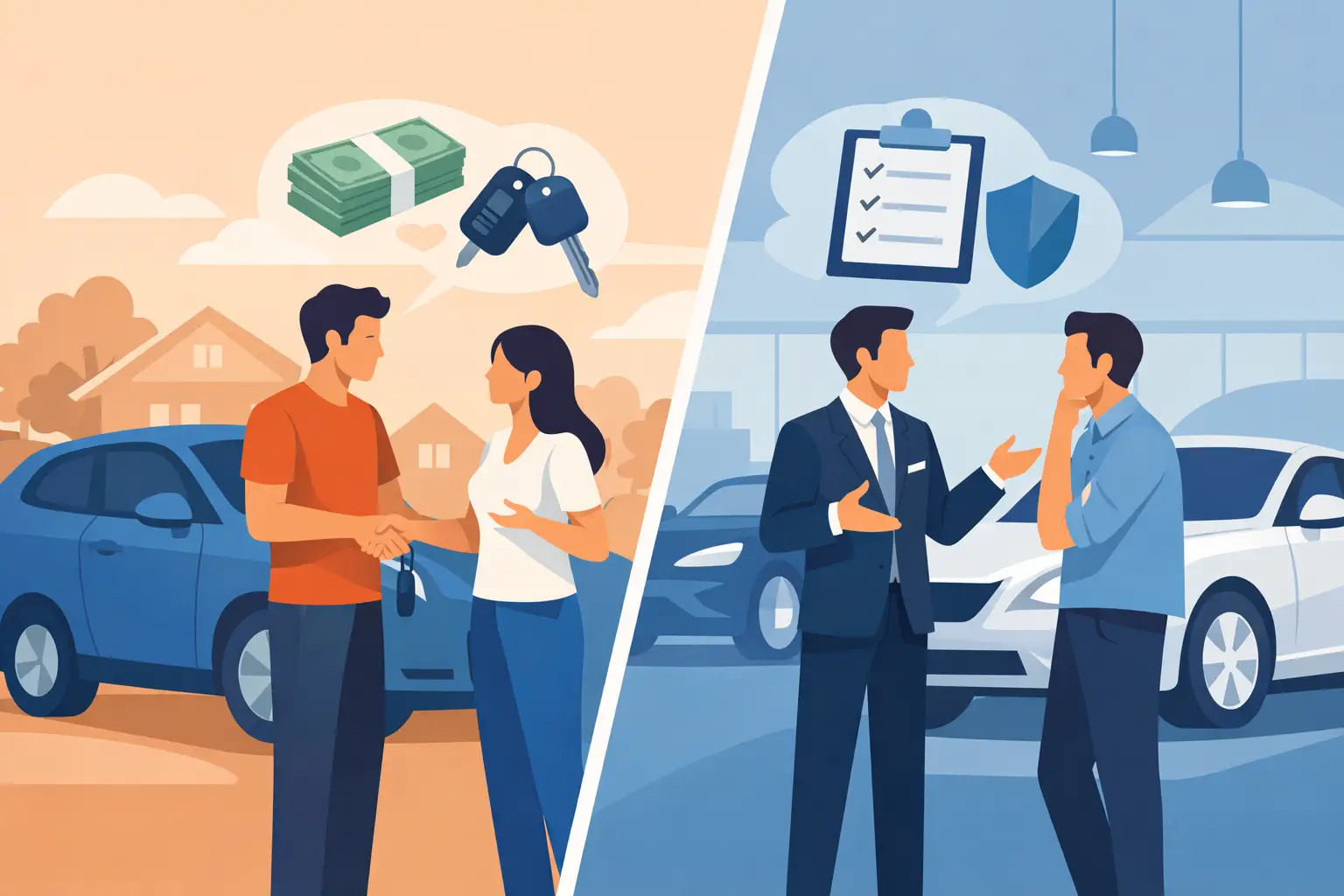
You find a car you like, then hit the first real fork in the road: private seller vs dealer. That choice affects more than price. It changes how much protection you get, how fast the deal moves, how much paperwork you handle, and how much risk lands on you.
For some buyers, a private sale is the fastest path to a lower price. For others, a dealer is worth the extra cost because financing, registration support, and legal structure reduce friction. The better option depends on your budget, your tolerance for risk, and how comfortable you are verifying a vehicle on your own.
Private seller vs dealer: the core difference
A private seller is usually an individual selling their own vehicle. A dealer is a licensed business selling inventory for profit. That basic difference shapes the entire buying process.
With a private seller, the transaction is usually simpler on the surface but heavier on buyer responsibility. You inspect the car, ask questions, verify title status, arrange payment, and handle most of the follow-through yourself. If something goes wrong after the sale, your options may be limited.
With a dealer, the process is more structured. You are more likely to see purchase documents, disclosures, financing options, and add-on products. The price may be higher, but the process is often easier to manage, especially if you need a loan, want to trade in a vehicle, or do not want to coordinate DMV steps on your own.
Price: where private sellers usually win
If your goal is to pay the lowest possible upfront price, private sellers often have the advantage. They do not carry dealership overhead like staff, buildings, reconditioning departments, or advertising budgets in the same way a retail dealer does. That can translate to lower asking prices.
Private sellers also tend to negotiate differently. Some just want the car gone and may accept a fair offer quickly. Others price emotionally and expect buyers to match their attachment to the vehicle. That makes each deal less predictable.
Dealers usually charge more, but the sticker price is not the full story. A dealer vehicle may have been inspected, cleaned, serviced, and prepared for sale. It may also come with limited warranty coverage, return policies in some cases, or at least more formal documentation. The higher price is partly paying for convenience and process.
The catch is that dealer pricing can include fees. Documentation fees, add-ons, and aftermarket products can move the total higher than expected. A low advertised price does not always mean a low out-the-door number.
Risk: where dealers usually have the edge
Risk is where the private seller vs dealer decision becomes more practical than theoretical. A private seller can offer a great vehicle at a fair price, but the burden of verification is on you.
You need to confirm the title is clean, the VIN matches, the odometer reading makes sense, and the seller has the legal right to sell the car. You also need to watch for hidden issues, unpaid liens, flood history, salvage branding, or signs that the car was flipped quickly with minimal disclosure.
A dealer is not risk-free, but the transaction usually comes with more structure. Licensed dealers are generally subject to state rules around disclosures, title handling, and sales practices. That does not mean every dealer sale is automatically safer, only that there is a business entity behind the transaction and usually a paper trail that is easier to follow.
If you are buying an older used vehicle either way, a pre-purchase inspection still matters. It is one of the few steps that protects you in both channels.
Financing and payment
This is one of the clearest dividing lines.
If you buy from a private seller, you will usually need cash or outside financing from a bank or credit union. That can work well if you are already preapproved. In fact, preapproval can make a private sale move quickly because you know your budget and can act fast when the right vehicle appears.
But private sales can be harder when timing, lender requirements, and title transfer details do not line up cleanly. Some lenders are stricter about older vehicles or private-party transactions. Payment logistics can also feel less straightforward, especially for first-time buyers.
Dealers make financing easier because they are set up for it. You can often shop, apply, and complete the purchase in one place. That convenience matters if you need a vehicle soon or want a simpler path from browsing to delivery.
The trade-off is cost. Dealer-arranged financing can be competitive, but not always. Rate, loan term, and monthly payment should all be reviewed carefully. A lower payment can hide a longer loan and a higher total cost.
Trade-ins, taxes, and paperwork
A dealer has a clear advantage if you want to trade in your current car. That removes the need to list it, field messages, meet strangers, and negotiate two separate transactions. You may get less than you would in a private sale, but you save time and reduce hassle.
Paperwork is another dividing line. In a private sale, you are responsible for making sure the bill of sale, title, release of liability, and any state-specific forms are correct. That is manageable, but it leaves more room for mistakes.
Dealers usually handle more of the process. They often process title and registration documents and may collect taxes and fees directly. For busy buyers, that convenience is worth real money.
Tax treatment can also matter. In some states, trading in a vehicle at a dealer can reduce the taxable amount on the next purchase. That can narrow the price gap between a dealer purchase and a private sale.
Vehicle selection and transparency
Private sellers usually offer one car. Dealers offer inventory. If you are still deciding between body styles, mileage ranges, trims, or brands, a dealer can save time because you can compare multiple vehicles in one stop.
That said, private sellers sometimes provide a more transparent ownership story. You may be talking directly to the person who drove the car, maintained it, and knows its quirks. That can be valuable. A long-term owner with service records can tell you more than a sales listing ever will.
At a dealer, the vehicle history may be better documented on paper, but the salesperson may know less about how the car was actually used day to day. So transparency depends less on seller type and more on how much documentation and direct information you can gather.
When a private seller makes more sense
A private seller is often the better fit if you have a clear budget, understand the car market, and are comfortable doing your own checks. It also makes sense if you are shopping for a lower-cost used vehicle where every dollar matters and you can handle your own financing or pay cash.
This route works best for buyers who are patient and disciplined. You need to verify details, inspect carefully, and walk away when something feels off. If you are rushed, private sales become riskier because bad assumptions are easier to make.
It can also be a strong option if you find a one-owner vehicle with maintenance records, a clean title, and a seller willing to meet at a mechanic for inspection. That is often the ideal private-party setup.
When a dealer makes more sense
A dealer is often the better fit if convenience is a priority. If you need financing, want to trade in a vehicle, prefer a more formal process, or do not want to manage DMV details yourself, a dealer can save time.
It also makes sense if you want more selection in one place or need to buy on a tighter schedule. For many buyers, speed matters just as much as price. A dealer is built for faster execution.
This route is especially useful for buyers who are newer to the process. If you are not confident in evaluating title issues, spotting mechanical red flags, or structuring a safe payment exchange, paying more for a dealer transaction may be the smarter move.
How to decide without overthinking it
Start with your constraints, not the listings. Ask yourself three simple questions: Do I need financing? Do I want to trade in my current car? Am I comfortable handling inspection, title verification, and paperwork myself?
If your answers are yes, yes, and no, a dealer is probably the cleaner path. If your answers are no, no, and yes, a private seller may offer better value.
Then look at the specific car, not just the seller type. A well-documented private sale can be safer than a vague dealer listing. A reputable dealer with transparent pricing can be a better buy than a private seller who cannot explain basic history. The channel matters, but the vehicle and paperwork matter more.
Platforms like AutosLinks help reduce search time, but the decision still comes down to how much cost, convenience, and risk you want to balance in one transaction.
The smart move is not picking a side in the private seller vs dealer debate. It is choosing the path that matches your experience level and the amount of work you are willing to do before you hand over the money.