
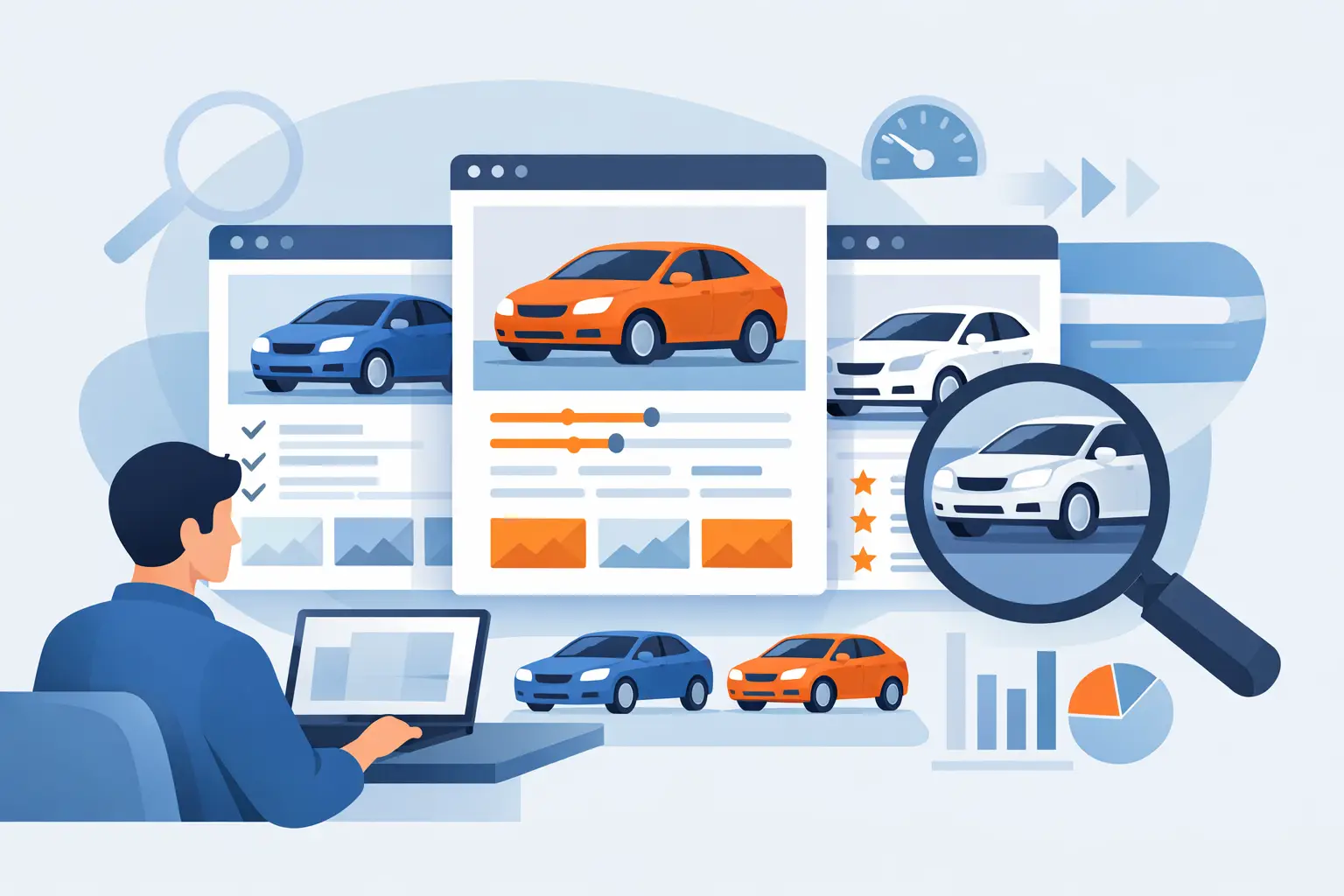
Most car shopping goes sideways before you ever contact a seller. It happens when you waste an hour on a listing site that looks polished but gives you thin inventory, stale prices, weak filters, or dealer pages that tell you almost nothing. If you want to know how to compare car listing sites, start by treating each platform like a tool, not a brand promise.
A good car listing site should help you narrow choices quickly, verify whether a vehicle is worth your time, and move you toward the next step without adding confusion. That sounds basic, but many sites do only part of the job well. Some are strong on inventory size but weak on transparency. Others have cleaner search tools but fewer fresh listings in your area. The right comparison comes down to what actually helps you shop faster and smarter.
How to compare car listing sites without wasting time
The easiest mistake is comparing sites by appearance. A better method is to run the same search across several platforms and judge what changes. Use one real target vehicle, one budget, one ZIP code, and one radius. That gives you a clean baseline.
For example, search for the same make, model, model year range, mileage limit, and price cap on each site. If one platform returns 220 vehicles and another returns 65, that gap matters - but not by itself. You still need to know whether those listings are current, well-labeled, and actually relevant to your search.
A site with fewer listings can still be more useful if the results are better filtered, the pricing is clearer, and the dealer information is stronger. Bigger is not always better. Cleaner data often saves more time than larger volume.
Start with inventory quality, not just inventory size
Listing count is the first thing shoppers notice because it is easy to measure. It is not the best measure. What you really want is inventory quality.
That means asking simple questions. Are listings detailed or vague? Do they include VINs, mileage, trim, accident history indicators, and enough photos to judge the vehicle? Are sold cars still showing up in search? Are duplicate listings cluttering the results? A site that pads volume with duplicates or stale units creates false choice.
Freshness matters just as much. If listings stay live long after the vehicle is gone, your search gets distorted. One practical test is to save or screenshot a small set of vehicles and check them again a few days later. If the same unavailable inventory keeps resurfacing, the platform may not be updating well.
Private seller and dealer mix also matters. If you want franchise-backed inventory with financing options, one site may fit better. If you are open to private-party pricing, another may surface more value. Neither is automatically better. It depends on your buying style and risk tolerance.
Check how well the site handles local search
Car shopping is local even when the platform is national. A site that looks strong overall may be weak in your actual market. Compare search results within a tight radius first, then expand. If relevant inventory only appears after you move out 100 or 200 miles, that affects transport costs, test-drive practicality, and negotiation leverage.
A useful site should make local availability obvious. You should be able to see where the car is, how far away it is, and whether the seller is a dealer, an independent lot, or a private owner without extra clicking.
Pricing data should help you judge value fast
The best car listing sites do more than display a price. They help you understand whether the asking price is competitive. Some platforms label deals as fair, good, or overpriced based on market data. That can be helpful, but do not treat those labels as final. Each site uses its own data model, and not all pricing tools weigh condition, options, and regional demand the same way.
What matters is consistency. If one site shows market context, price history, recent reductions, and similar local comps, it gives you more leverage. If another only shows the ask with no context, you have to do more work yourself.
Watch for fees and missing detail. A low advertised price can look great until dealer add-ons, shipping charges, reconditioning fees, or mandatory packages show up later. A strong listing platform will not always control dealer behavior, but it should make seller disclosures easier to spot.
Compare price transparency across listings
Run a second test after your main search. Pick five similar vehicles on each site and look at how much effort it takes to answer basic pricing questions. Is the out-the-door estimate visible? Are dealer fees mentioned? Is payment information realistic or just marketing math based on a large down payment?
If a platform consistently pushes low monthly payments while burying the vehicle price or terms, that is a signal. Good comparison tools reduce ambiguity. Weak ones make you chase it.
Filters and sort tools decide how usable a site really is
Search filters are where many platforms separate themselves. If you cannot quickly remove rebuilt titles, set a mileage ceiling, choose drivetrain, trim, body style, and feature requirements, the site is slowing you down.
This is especially important in crowded categories like midsize SUVs, half-ton trucks, and compact crossovers. Small differences in trim and equipment can change value by thousands of dollars. A site that lets you filter by adaptive cruise control, third-row seating, towing package, or certified status can save a lot of wasted clicks.
Sorting also matters more than it seems. You should be able to sort by newest listings, lowest mileage, lowest price, distance, and ideally best market value. Some sites bury these controls or reset filters too often. That friction adds up fast.
Mobile experience matters here too. Many shoppers start on a phone, save listings, then revisit later on a desktop. If saved searches, alerts, and comparison features do not carry over cleanly, the site becomes less useful in real life.
Seller detail is a major part of site quality
A listing is only as useful as the seller behind it. Two platforms can show the same vehicle, but one may do a much better job presenting seller credibility.
When comparing car listing sites, check how much context they give you about the dealer or private seller. Can you see store ratings, response behavior, location accuracy, and how long the vehicle has been listed? Is the seller profile informative or nearly empty? Do you have a clear way to contact them without creating extra steps?
Lead flow matters here. Some sites pass your inquiry directly to the seller. Others route it through extra layers, which can slow responses or increase spam. A simple test is to see how many fields a contact form requires and whether phone, text, and email options are clearly available. The shorter and clearer the path, the better.
For dealer inventory, it also helps if the site surfaces basics such as financing availability, trade-in support, return policies, and whether home delivery is offered. You may not need all of that, but having it up front helps you compare sellers instead of just cars.
Watch for signals of trust, but keep your standards realistic
No listing platform is perfect. Even strong sites depend on feeds from dealers, third-party data providers, and sellers who do not always update information quickly. The goal is not perfection. It is fewer bad surprises.
Trust signals include VIN-based vehicle details, clear photo sets, accident or title flags, price history, and consistent listing formats. These features lower risk because they make omissions easier to spot. If half the listings on a site lack photos, trim information, or seller detail, your confidence should drop.
At the same time, do not overvalue labels alone. A vehicle marked as a great deal is still worth checking for condition, ownership history, service records, and local demand. A site can support your decision, but it cannot replace judgment.
The best site depends on what stage you are in
Early-stage shoppers usually need broad coverage, strong filters, and alerts. At that point, the best site is the one that helps you map the market quickly. Mid-stage shoppers need price context, seller detail, and clean saving tools so they can narrow options. Late-stage buyers need direct contact paths, accurate listing status, and enough transparency to book a test drive without starting over.
That is why one-site shopping rarely works well. A practical setup is to use one platform for broad discovery, another for price validation, and a final check for seller credibility or local overlap. AutosLinks fits naturally into that behavior because many shoppers are not looking for one destination forever. They are looking for the fastest route to the right next step.
If you want the simplest way to compare, run the same search on three sites, evaluate inventory freshness, pricing context, filter quality, seller detail, and contact friction, then keep the one that saves you the most decisions per minute. The best car listing site is not the one with the loudest ads. It is the one that gets you to a solid vehicle with the fewest dead ends.